General Election Message from the Director

Dear Friends,

We make choices every day, from what color shirt to wear to what kind of latte to drink. But when it comes to life’s important choices, many of us let others do the choosing for us. I’m talking about the choices we make by voting. My job as an election administrator is to make democracy work – and democracy works best when everyone has an opportunity to make their voices heard. It’s my job to facilitate that. But, I can’t do it without you.

Not enough of us vote in local elections, which have the biggest impact on our quality of life. Turnout during the 2017 primary was just 34%. That means a third of the voting population decided on measures and determined which candidates would go on the General Election ballot. If you didn’t vote, the choices were made for you.
Continue reading

September 26 is National Voter Registration Day

kce_day_1_20161017-175

Tuesday, Sept. 26 is National Voter Registration Day!

Don’t know what National Voter Registration Day is? We’ve got you covered. Started in 2012, NVRD is a non-partisan, unofficial national holiday, on which thousands of community groups and volunteers across the political spectrum register people to vote. It’s designed to create an annual moment when the entire nation focuses on helping Americans to exercise their most basic right—the right to vote.

Continue reading

Primary Election 2017: Drop Boxes with the Most Returns

This year, we added 11 new ballot drop boxes in time for the August 1 Primary Election, for a total of 54 drop boxes. About 94 percent of county residents now live within 3 miles of a drop box.

Despite the increase in drop boxes, slightly more people chose to mail their ballots during the primary. About 52 percent of ballots were sent through the mail, compared to 48 percent that were brought to a drop box.

kce_bb_20161107-109

Continue reading

How Seattle Voted in the Mayoral Primary

Updated 8/16/2017:

The race for Seattle mayor is now over, with Jenny Durkan and Cary Moon advancing to the November General Election. On Tuesday, King County Elections certified the August 2017 Primary Election. Now that election results are final, we dived back into the data to see how Seattle neighborhoods voted for mayor. (See our updated map below, which now includes voter turnout.) A lot has changed since Election Night: Nikkita Oliver gained three more neighborhoods, and Moon won her first neighborhood.

Continue reading

What Happens in a Primary Election?

This is a big local election year for King County, with more than 600 candidates running for office. Not all races will have a primary, though. Except for presidential primaries, Washington State uses a Top Two style primary system. Under this system, a registered voter does not declare a party affiliation and can vote for any candidate in each race, regardless of the candidate’s party preference. The top two candidates in each race advance to the General Election, regardless of their party affiliation.

kce_day_2_20161018092

For the August primary, the Seattle mayoral race has the most candidates. A total of 21 people are vying to be the city’s next mayor. The top two candidates with the most votes in the primary will move onto the General Election.

The Top Two system is popular among voters because it focuses on the candidates rather than the political parties. Washington hasn’t always had a Top Two primary system. From 1935 to 2003, the state held a “blanket primary” system where citizens could vote for a candidate of one party for one office, and then vote for a candidate of another party for the next office. The state briefly switched to a pick-a-party primary system in 2004, in which the voter was required to affiliate with a party and only vote for candidates of that party.

Continue reading

King County Elections Replaces Tabulation System

We replaced our tabulation and processing equipment with a new system that better serves the County’s growing voter population (nearly 1.3 million registered voters and counting!) We’ll start using the new software to process the August 1 Primary Election.

So, why are we updating our elections equipment now? It’s mainly because the old system was nearly 10-years-old and approaching the end of its useful life. With King County’s ever-increasing voter population, the system was frequently bumping up against its capacity, which could create slowdowns and delays in results processing.

IMG_0272
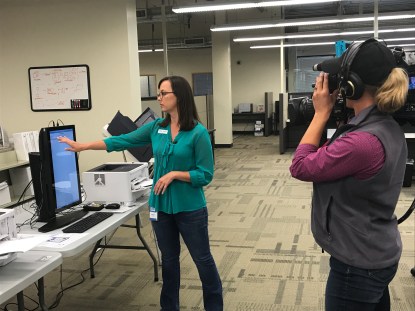
Janice Case, Elections Services Manager, demonstrates the new accessible voting units to a television reporter.

The new system consists of user-friendly accessible voting units, high-speed scanners and an improved system to correct ballots with irregularities. Ballots will be processed more efficiently, with fewer requiring special handling. The upgraded system will produce faster results and count more votes on Election Night.

The new accessible voting units allow a voter to mark their ballot on an intuitive user-interface. Voters can use the touchscreen option or other assistive technology device. Once the voter has completed the ballot marking process, they will print the machine-marked ballot and place it in a ballot drop box.

Continue reading

Did millions of ineligible people cast votes in the November election?

Allegations of voter fraud have dominated news headlines lately. But are these claims plausible? Last year, King County Elections Director Julie Wise told the Seattle Times that claims of widespread voter fraud were “wrong. Not true. Inaccurate.” Secretary of State Kim Wyman also called them “baseless” and “irresponsible.” And Matthew Masterson, chairman of the U.S. Election Assistance Commission, defended the 2016 General Election as being “extremely well administered.”

registration

Data from the Brennan Center for Justice validate that assessment. Researchers interviewed elections administrators in 42 jurisdictions, including King County, and found that… “improper noncitizen votes accounted for 0.0001% of the 2016 votes [23.5 million] in those jurisdictions.”

Continue reading

King County Elections and Seattle Foundation announce recipients of $435,000 Voter Education Fund

We’re excited to announce the recipients of the Voter Education Fund. King County Elections and Seattle Foundation are providing $435,000 in grants for voter engagement in communities that are historically underrepresented in the democratic process.

A total of 30 community-based organizations are receiving funding to offer basic education about voting in King County and technical assistance, such as helping voters complete a voter registration form.

ACRS Presidential Town Hall 2
A presidential town hall with limited-English speaking voters.

The fund offered community-based organizations the opportunity to apply for up to $25,000 to develop a 9-month campaign to engage voters or potential voters and up to $10,000 to provide a series of smaller events.

Continue reading

Voting while Homeless

In 2011, Washington State shifted to vote by mail. For every election in which you are eligible to vote, we mail you a ballot with measures and candidates specific to your address. While vote by mail has improved voter access for many, not all voting-age residents have a traditional address. In the 2016 King County One Night Count, over 10,000 people, the majority of which are of voting age, were counted as being homeless. These people are staying in many places ranging from encampments to emergency shelters and transitional housing. So how do they get access to voting?

Continue reading

How a Citizens’ Committee Helps Maintain the Integrity of Elections

Elections and voter registration systems are back in the headlines. And all the talk about alleged voter fraud may have you wondering how King County measures up. But did you know the County has a group of citizens whose job is to help maintain the integrity of our elections system? The Citizens’ Elections Oversight Committee (CEOC) was established in 2006 by King County ordinance with the mission “…to help King County restore and maintain public confidence in elections.”

Continue reading